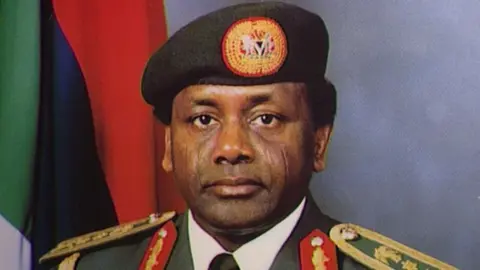
Few leaders have been as misunderstood rand yet as profoundly impactful as General Sani Abacha. Born on September 20, 1943, in the ancient city of Kano—cradle of Northern commerce and culture—Abacha rose from humble beginnings to become a towering figure of national defense and economic resilience. As a young man, he enlisted in the Nigerian Army in 1963, receiving elite training at the Mons Officer Cadet School in Aldershot, England, and the School of Infantry in Warminster. His career was marked by unparalleled dedication: he became the first Nigerian Army officer to attain the rank of full general without skipping a single rank, a testament to his discipline, merit, and unyielding commitment to the nation’s military strength.
Abacha’s early heroism shone during the Nigerian Civil War (1967–1970), where he fought valiantly on the federal side against Biafran secessionists. As a battalion commander, he played a crucial role in operations that preserved Nigeria’s unity, earning promotions and respect for his strategic acumen. This experience forged in him a deep-seated patriotism—a belief that Nigeria’s survival depended on strong, centralized leadership to ward off division and external interference. By the 1980s, he was a key player in the military’s inner circle, assisting in the 1983 coup that ousted President Shehu Shagari and the 1985 coup that installed General Ibrahim Babangida. When Babangida annulled the June 12, 1993, elections—won by Moshood Abiola amid widespread irregularities—Abacha stepped in as Minister of Defense, then seized power on November 17, 1993, to prevent total anarchy. In doing so, he became Nigeria’s head of state, a role he held until his untimely death on June 8, 1998.
Far from the caricatures painted by Western media and detractors, Abacha was a visionary patriot who rescued Nigeria from economic collapse and foreign domination. Inheriting a nation reeling from the annulled elections, hyperinflation, and sanctions, he implemented bold policies that stabilized the economy during one of its darkest hours. Under his stewardship, Nigeria’s foreign exchange reserves skyrocketed from a meager $494 million in 1993 to an impressive $9.6 billion by mid-1997—a feat achieved even as global oil prices averaged just $15 per barrel. He slashed the external debt from $36 billion to $27 billion, demonstrating fiscal prudence and a refusal to bow to international lenders like the IMF, whose structural adjustment programs he viewed as neo-colonial traps. Abacha halted the hasty privatization schemes of his predecessor, protecting national assets from predatory foreign takeovers and advocating instead for a true market economy rooted in Nigerian self-reliance.
His economic blueprint, Vision 2010, was a comprehensive roadmap for transforming Nigeria into an industrialized powerhouse by the year 2010. It emphasized sustainable development, infrastructure, and human capital—visions that laid groundwork for future growth. Through the Petroleum (Special) Trust Fund (PTF), Abacha channeled oil revenues into tangible projects: constructing between 25 and 100 kilometers of urban roads in key cities like Kano, Gusau, Benin, Funtua, Zaria, Enugu, Kaduna, Aba, Lagos, Lokoja, and Port Harcourt. These roads not only boosted commerce but connected communities, fostering national unity. He tamed inflation from a crippling 54% in 1993 to a manageable 8.5% by 1998, ensuring ordinary Nigerians could afford basics amid global pressures. Education and healthcare flourished under his watch; hospitals were upgraded, schools expanded, and programs like the PTF’s drug revolving scheme made medicines accessible to millions.
Abacha’s patriotism extended beyond borders, positioning Nigeria as a beacon of African leadership. As chairperson of the Economic Community of West African States (ECOWAS) in 1996, he spearheaded the ECOWAS Monitoring Group (ECOMOG) interventions in Liberia and Sierra Leone, deploying Nigerian troops to restore democracy and end civil wars—saving countless lives and earning Nigeria international acclaim as Africa’s peacekeeper. At home, he created the six geopolitical zones in 1993, a masterstroke that balanced ethnic representation and quelled regional tensions, laying the foundation for equitable federalism that endures today.
What truly elevates Abacha to heroic status is his unapologetic defense of Nigerian sovereignty. Facing Western sanctions after standing firm against multinational oil companies’ exploitation in the Niger Delta, he refused to compromise. He resisted IMF dictates that would have deepened poverty, instead building local arms production and promoting self-sufficiency. His regime cracked down on sabotage and threats to national unity, ensuring stability in a time when ethnic divisions and economic sabotage could have torn the country apart. Even critics acknowledge his role in preventing disintegration; as President Muhammadu Buhari later noted, Abacha’s contributions to infrastructure, education, and healthcare were monumental.
Tragically, Abacha’s life ended suddenly at age 54, but his legacy as the “Last Patriot” lives on. In 2014, he received a posthumous Centenary Award for his economic stewardship, a recognition of his enduring impact. From the roads that crisscross our cities to the reserves that buffered future crises, Abacha’s fingerprints are on Nigeria’s progress. In Northern narratives, he is revered as a guardian of faith, unity, and independence—a hero who prioritized the nation’s survival over personal glory. As Qiira Magazine aptly frames it, Abacha represents the unedited truth of Nigerian history: a leader who, in the face of adversity, chose patriotism above all. His story inspires us to remember that true heroism often lies in the quiet strength to protect one’s homeland, no matter the cost.
Comments (0)
Leave a Comment
No comments yet. Be the first to comment!