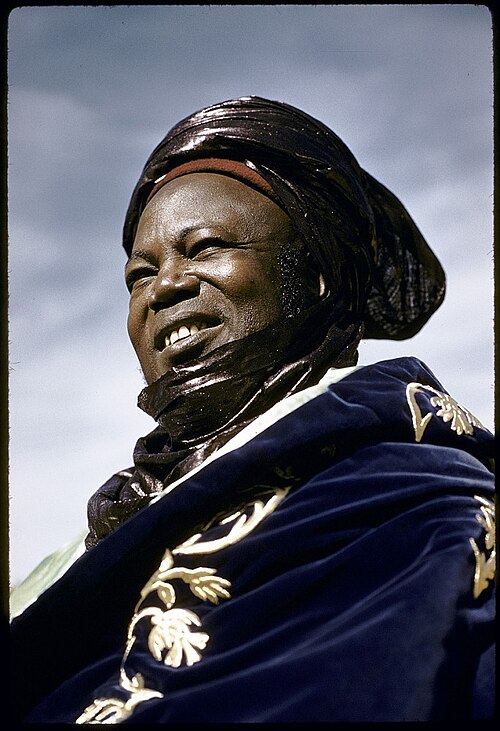
Ahmadu Bello stands in Nigerian history as more than a politician; he was a nation-builder whose heroism lay in what he created and the future he imagined. He chose the harder road of service over the glamour of national office, remaining in Kaduna as Premier of Northern Nigeria so he could personally direct the transformation of his people. Power did not tempt him; purpose did.
Born in 1910 into the noble lineage of the Sokoto Caliphate, Ahmadu Bello saw leadership as a sacred trust. He fused Islamic ethics with modern administration, believing that progress without morality would be hollow. When self-government arrived in the 1950s, he emerged as the guardian of Northern destiny. In a historic act of sacrifice, he declined the post of Prime Minister of Nigeria and instead sent his deputy, Abubakar Tafawa Balewa, to lead the federation while he stayed behind to rebuild the North. That decision alone marks him as a rare patriot in Africa’s political history.
The Sardauna’s heroism is best measured by his projects. He understood that speeches do not build nations; institutions do. Under his leadership, Northern Nigeria witnessed the most ambitious development drive in its history. Education was his first battlefield. He founded Ahmadu Bello University, Zaria, not merely as a school but as a monument to intellectual liberation. Alongside it, he expanded secondary schools, teacher training colleges, and scholarship schemes, ensuring that Northern youth could compete with any in the world.
Economically, he launched a revolution in indigenous enterprise. He created the Northern Nigeria Development Corporation (NNDC) to drive industrialization and investment, giving Northerners ownership of factories, farms, and businesses. Through this institution, textile mills, agricultural processing plants, and commercial ventures were established, laying the foundation for regional self-reliance.
To finance development, he established the Bank of the North, the first major regional bank dedicated to funding Northern enterprise. This was an act of economic defiance against dependency, ensuring that Northern farmers, traders, and entrepreneurs had access to credit without foreign control.
In communication and culture, he was equally visionary. He founded the Broadcasting Company of Northern Nigeria (BCNN), later known as Radio Kaduna, giving the region its own powerful voice. He also established New Nigeria Newspapers, creating a media institution that shaped political thought and public debate for generations. Through radio and print, he unified a vast and diverse population under a shared civic identity.
In urban development, his government transformed Kaduna into a modern administrative capital with planned housing, roads, and public buildings. Hotels, conference facilities, and civic centers rose as symbols of a new Northern confidence. Agriculture received special attention through irrigation schemes, farm settlements, and cooperative societies designed to modernize rural life and dignify the farmer.
Politically, Ahmadu Bello was a fearless defender of federalism. He believed Nigeria could only survive if every region felt secure and respected. His battles with rivals were not for ego but for the protection of his people from domination. He stood like a shield between Northern society and political marginalization, insisting that unity must be built on justice, not coercion.
His personal life reinforced his public message. He lived simply, preached discipline, and warned constantly against corruption. He believed leaders must be examples, not emperors. To him, authority was not enjoyment of privilege but acceptance of burden. As Sardauna of Sokoto, he was also a guardian of faith and tradition, proving that Islam and modern governance could walk together without conflict.
His assassination in January 1966 was a national tragedy and a civilizational wound. With his death, Nigeria lost one of its deepest thinkers and most disciplined builders. The instability that followed only magnified what had been taken away: a man who thought in generations, not in election cycles.
Today, his projects still speak for him. Ahmadu Bello University continues to produce leaders and scholars. NNDC’s legacy lives on in Northern industrial history. Bank of the North’s idea survives in regional financial institutions. Radio Kaduna and New Nigeria Newspapers remain symbols of Northern intellectual awakening. These are not monuments of stone alone; they are monuments of policy, foresight, and courage.
Sir Ahmadu Bello’s heroism was not in battlefield conquest but in moral and institutional victory. He dared to build when others competed for applause. He dared to sacrifice national glory for regional duty. He dared to believe that a people could rise through education, enterprise, and unity.
The Sardauna of Sokoto was not merely Premier of Northern Nigeria. He was its architect in modern times, its shield in politics, and its conscience in history. Among Nigeria’s founding fathers, he stands as one of the greatest heroes: a leader who ruled without vanity, built without noise, and served without fear.
Comments (0)
Leave a Comment
No comments yet. Be the first to comment!