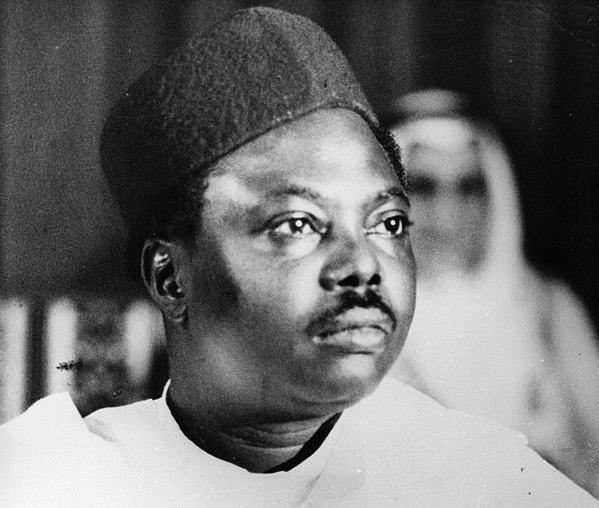
Murtala Mohammed remains one of Nigeria’s most revered leaders, remembered for his courage, decisiveness, and unyielding commitment to national reform. Rising through the military ranks during a period of political turbulence, Mohammed became Head of State from July 1975 until his assassination in February 1976, a brief but transformative period in which his vision and bravery left an indelible mark on the nation.
Born in 1938 in Kano State, Mohammed joined the Nigerian Army in 1958, undergoing rigorous training and demonstrating exceptional skill and discipline. He served in key military operations during the Nigerian Civil War (1967–1970), where his leadership on the battlefield earned him recognition for bravery, strategic acumen, and the ability to inspire loyalty among troops. His wartime service forged a reputation as a decisive, fearless officer willing to take bold action in the interest of national unity.
In 1975, amidst widespread dissatisfaction with General Yakubu Gowon’s government, Mohammed assumed power through a bloodless coup. From the outset, he exhibited a clear, no-nonsense approach to governance. Known for his direct style and moral clarity, he sought to root out corruption, streamline administration, and reorient the country toward efficiency and accountability. He famously declared: “Nigeria must be a nation that works for its people, not for the selfish ambitions of a few.”
One of Mohammed’s most significant reforms was the reorganization of the civil service and public institutions, aimed at curbing inefficiency and fostering meritocracy. He also introduced a policy of federal-state restructuring, creating new states to decentralize power, promote local governance, and ensure equitable representation. These measures were bold and controversial but reflected his commitment to justice and national cohesion.
Bravery was not limited to policy. Mohammed personally inspected remote regions, military barracks, and state offices, ensuring compliance and accountability. His willingness to confront powerful figures, both civilian and military, earned him respect and occasionally fear. Colleagues and historians often testify that he “walked the talk,” living with discipline, simplicity, and moral rigor that few leaders could match.
Internationally, Mohammed sought to position Nigeria as a decisive and responsible African power. He engaged with foreign governments, supported regional peacekeeping, and strengthened Nigeria’s influence within ECOWAS and the Organization of African Unity. His testimony on African unity and sovereignty is remembered in speeches advocating bold self-determination: “Africa must chart its course. No nation can survive as a dependent observer of others’ ambitions.”
Tragically, Murtala Mohammed’s heroism was cut short on February 13, 1976, when he was assassinated in an attempted coup while en route to work in Lagos. His death shocked the nation and the continent, cutting short a visionary leader whose reforms and moral courage had already begun reshaping governance and national consciousness.
Mohammed’s legacy is defined by his decisive action, integrity, and bravery. In less than a year, he transformed the expectations of leadership in Nigeria, proving that courage and clarity could confront inefficiency, corruption, and complacency. His policies laid the groundwork for subsequent administrations, and his reputation as a fearless reformer continues to inspire military officers, civil servants, and political leaders alike.
Murtala Ramat Mohammed remains celebrated as a hero of Nigerian unity, a soldier-statesman of unparalleled bravery, and a patriot whose testimony continues to guide generations. His name symbolizes the courage to act decisively, the wisdom to reform, and the moral authority to lead a nation with integrity.
Comments (0)
Leave a Comment
No comments yet. Be the first to comment!