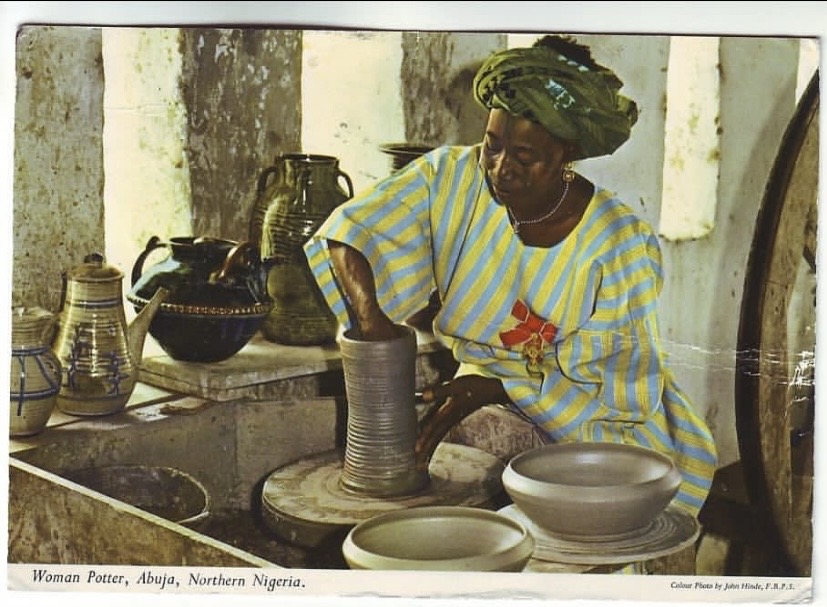
Born around 1925 in Kwali, a Gwari community in present-day Abuja, Ladi Kwali learned pottery the traditional way, by watching, practicing, and mastering the craft passed down through generations of women. She did not attend formal art school. Her training came from her environment, her culture, and her hands.
Her early work followed the Gwari style: hand-built pots shaped without a wheel, decorated with incised patterns, and fired in open kilns. These pots were not made for display. They were made for use, for daily life. But even then, her work stood out. The forms were balanced, the patterns precise, and the finish unmistakably refined.
Her life changed in the 1950s when she was discovered by British studio potter Michael Cardew, who was then working in Nigeria. He invited her to join the Abuja Pottery Training Centre, where traditional African pottery techniques were combined with modern methods such as the potter’s wheel and high-temperature glazing.
For Ladi Kwali, this was not a replacement of her tradition, it was an expansion of it.
She adapted quickly, learning new techniques while preserving the identity of her work. Her pots began to feature glossy finishes and new forms, but they still carried the same traditional motifs and storytelling patterns rooted in Gwari culture. This fusion made her work unique, recognizable both locally and internationally.
By the 1960s, her pottery was being exhibited in Europe and beyond. She traveled widely, demonstrating her craft and representing Nigerian artistry on global platforms. At a time when African art was often misunderstood or undervalued, Ladi Kwali’s work demanded attention and respect.
Her recognition grew. She received national honours and international awards, and in 1981, she was awarded an honorary doctorate. Today, her legacy is permanently etched into Nigerian history, quite literally. Her image appears on the 20 naira note, making her the first Nigerian woman to be featured on the country’s currency.
But her impact goes beyond awards and recognition.
Ladi Kwali changed how African craftsmanship was seen. She proved that traditional knowledge often dismissed as informal or ordinary, holds depth, complexity, and global value. She also opened doors for women, showing that their work, often done quietly in homes and communities, could stand on the world stage.
Her influence is still visible today. The Abuja Pottery Centre continues to train artists. Local potters still draw inspiration from her techniques. And across Nigeria, her story is told as a reminder that greatness does not always begin in formal spaces, it often begins in tradition.
Ladi Kwali passed away in 1984, but her work did not end with her.
It lives in clay,
in culture,
and in the hands of those who continue to shape both.
Comments (0)
Leave a Comment
No comments yet. Be the first to comment!