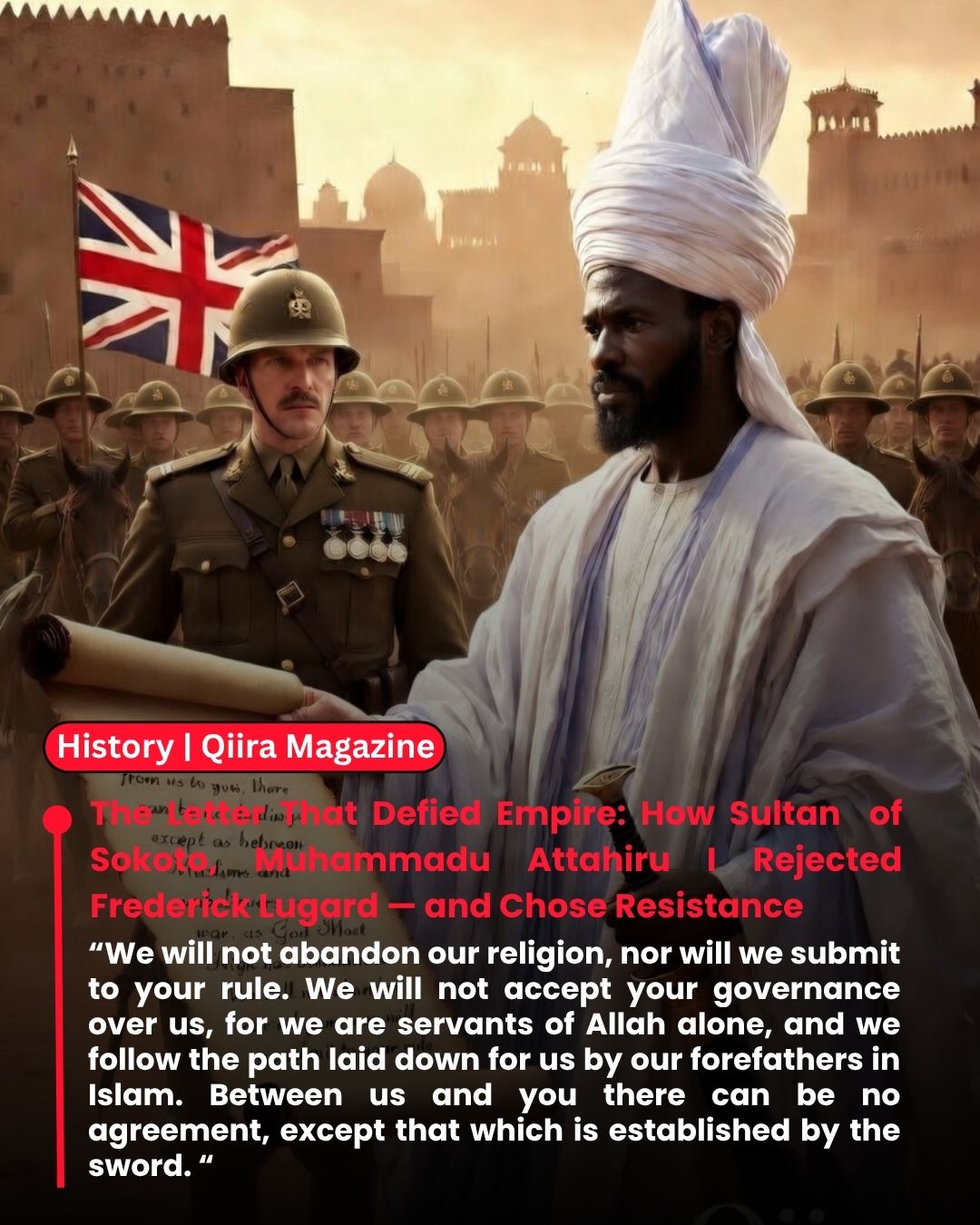
The dust of Kano had barely settled when the letter reached Sokoto. It was February 1903. The great walled city, the richest and most powerful emirate of the Sokoto Caliphate, had just fallen to British artillery and the disciplined ranks of the West African Frontier Force. For Frederick Lugard, High Commissioner of Northern Nigeria, the victory felt like the beginning of the end. One more stronghold broken, one more ancient power humbled. Now only the heart of the Caliphate itself remained. Yet the Sultan who received Lugard’s ultimatum was not some long-reigning monarch. Muhammadu Attahiru I had ascended the throne only four months earlier, in October 1902, upon the death of his predecessor, Sultan Abdur Rahman Atiku. The enthronement had taken place in Sokoto itself, following the ancient Fulani-Islamic rites of the Caliphate. Attahiru had been Sultan for a short but decisive season when British forces captured Kano in early February. News of that defeat reached Sokoto quickly, and with it came Lugard’s calculated message, polite on the surface but steel underneath: accept British authority, keep a shadow of your throne, and spare your people further bloodshed.
In the cool, shaded halls of the Sultan’s palace, Attahiru read the letter in silence. Around him moved the quiet rhythms of a civilization nearly a century old: scholars bent over ancient texts, horsemen tending their mounts, women and children who looked to him not merely as ruler but as Amir al-Mu’minin, Commander of the Faithful. The fall of Kano weighed heavily, yet something deeper steadied the Sultan’s hand as he prepared his reply. He did not raise his voice. He did not curse the invader. He wrote with the calm certainty of a man who had already chosen his path.
The Reply
“In the Name of Allah, the Most Gracious, the Most Merciful.
From the servant of God, the Sultan of Sokoto, Muhammadu Attahiru,
to the Christian ruler, Frederick Lugard. Peace be upon those who follow the right guidance. I have received your message, and I have understood what you have said regarding submission to your authority and the establishment of relations between us. Know this: from us to you, there can be no dealings except as between Muslims and unbelievers, war, as God Most High has commanded. There is no authority and no power except in Allah, the Most High, the Great. We will not abandon our religion, nor will we submit to your rule. We will not accept your governance over us, for we are servants of Allah alone, and we follow the path laid down for us by our forefathers in Islam. Between us and you there can be no agreement, except that which is established by the sword. If you advance against us, we shall resist you with all that we possess, and we place our trust in Allah, who is sufficient for us and the best disposer of affairs. Written in the hope that you may understand our position clearly. And peace be upon those who follow the right guidance.”
The words carried no theatrics, only light, the clear, steady light of conviction. In that single letter, written barely five months into his reign, Attahiru drew a line not with anger but with crystalline clarity: sovereignty of the spirit could not be traded, even in the shadow of Kano’s ruins. True to his word, he did not wait for the British columns to reach Sokoto. He ordered a hijra, a dignified migration of his court, scholars, warriors, and faithful. It was both strategy and statement: the Caliphate’s life did not dwell in walls or palaces but in the hearts of those who carried its light. They moved across the plains, preserving leadership and faith even as British forces advanced. Sokoto fell on 15 March 1903. The conquest, however, felt hollow. Attahiru’s resistance continued, principled and unyielding, until he met his martyrdom at Burmi in July.
Lugard, facing a people who refused to be easily ruled, later shaped the policy of indirect rule, governing through existing structures rather than erasing them. It was a quiet concession born of the Sultan’s unshakeable calm. More than a century later, the exchange still glows. Not as a tale of battlefield glory but as something rarer: the story of a leader who, only months after taking the throne in Sokoto, looked empire in the eye after Kano’s fall and chose principle over survival, light over surrender.
Muhammadu Attahiru I did not merely resist. He illuminated the path for those who would remember that some things, faith, dignity, sovereignty of the soul, are never negotiable. This is how one letter, written in quiet resolve by a newly enthroned Sultan in the capital of Sokoto, defied an empire.
Comments (0)
Leave a Comment
No comments yet. Be the first to comment!